Project Details
-
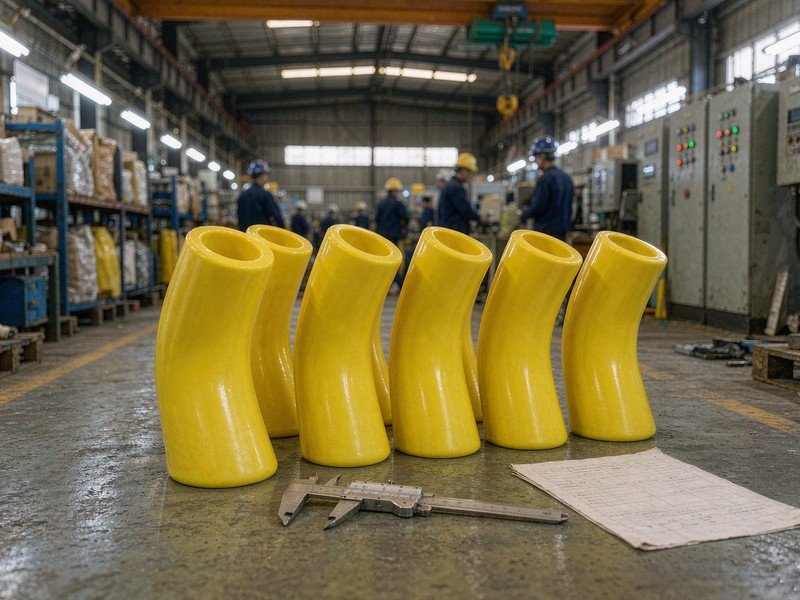
- Category Subsea Cable Protection System
- Date Sep 14,2026
- Hits 2
- Website https://www.ppdi-ndi.com
Custom Submarine Cable Bend Restrictor
Polyurethane bend restrictors protect submarine cables at bellmouths and J-tubes. Compare polyurethane vs steel vs nylon for MBR control, corrosion and cost.
Article Outline
An overview of polyurethane bend restrictors for submarine cables, covering design, customization, applications, and installation.
📌 Introduction to Submarine Cable Bend Restrictors
🔍 Polyurethane: Material Properties and Advantages
💡 Custom Design and Engineering Considerations
📊 Applications and Installation Guidelines
🎯 Conclusion and Future Trends
Introduction to Submarine Cable Bend Restrictors
Subsea cable failures stem from various causes, yet excessive bending is among the most avoidable. Bend limiters provide mechanical protection at critical transition points—such as vessel bell-mouths, J-tube exits, and touchdown zones—where the cable shifts from a dynamic to a static state. Operating via discrete, interlocking elements, they allow for controlled bending of the cable while preventing it from exceeding its specified minimum bending radius (MBR). Although bend stiffeners are often considered to offer superior fatigue resistance for deepwater riser applications, bend limiters provide comparable protection for subsea power cables in shallow to intermediate waters at a significantly lower cost and level of complexity. The key issue is not which device is superior in every scenario, but rather which is best suited to the specific loading conditions and installation method.
Polyurethane: Material Properties and Advantages
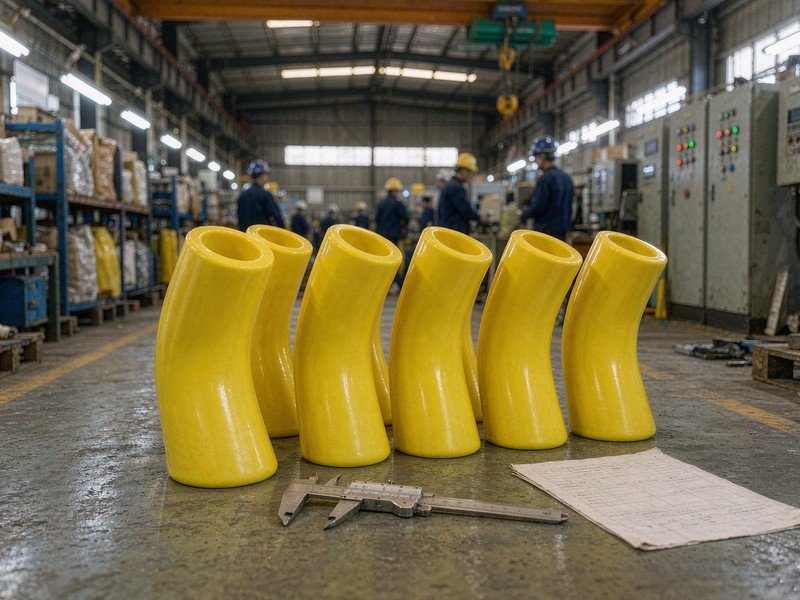
Polyurethane dominates bend restrictor manufacturing not by tradition but by measurable performance. Its high tensile strength and tear resistance allow thin-walled elements that interlock without cracking under repeated flexing. More importantly, polyurethane can be formulated to achieve a precise Shore D hardness—typically 55D to 75D—balancing rigidity against the flexibility needed for installation. Compare this to steel: steel restrictors resist bending but corrode in seawater and add substantial weight, complicating deployment. Nylon offers good strength but absorbs water and swells, altering the MBR unpredictably. Polyurethane's hydrolytic stability and UV resistance make it the pragmatic choice for long-term subsea exposure.
| Property | Polyurethane (55D–75D) | Steel (316L) | Nylon (PA12) |
|---|---|---|---|
| Density (g/cm³) | 1.05–1.20 | 7.98 | 1.02 |
| Water absorption (%) | <0.5 | Nil | 1.5–2.5 |
| Typical MBR control | Excellent | Good | Moderate |
| Corrosion risk | None | High | None |
| Relative cost | Moderate | High | Low |
Custom Design and Engineering Considerations
Off-the-shelf restrictors fail where custom engineering succeeds. The design process begins with the cable's minimum bend radius, outer diameter, and anticipated axial and torsional loads. A common mistake is specifying restrictor length by rule of thumb—"five times the diameter"—rather than calculating the strain distribution along the articulated section. Each interlocking element must be sized so that the cumulative angular deflection never exceeds the cable's safe curvature. Customization also extends to end terminations: flanged interfaces for J-tubes, tapered entries for bellmouths, and split designs for retrofitting onto existing cables without cutting. The argument for standardization loses force when a single mis-sized element can cause conductor fatigue or armor birdcaging. Custom polyurethane casting allows wall thickness, element count, and interface geometry to be tuned independently—an advantage no catalog product can match.
Applications and Installation Guidelines
Bend restrictors prove their worth in three arenas: offshore wind export cables, oil and gas umbilical terminations, and telecommunications repeaters. In each, the installation method dictates the restrictor's configuration. For J-tube pull-ins, a tapered, low-friction outer profile reduces pulling tension. For overboarding through a bellmouth, a flexible root section accommodates vessel motion. Installation errors—misaligned elements, omitted locking pins, or excessive pre-bend—account for a disproportionate share of restrictor failures. Field experience suggests that a pre-installation fit-check on deck, followed by diver or ROV verification of element engagement, prevents most failures. Some operators skip the fit-check to save time; this false economy has led to restrictor disengagement and subsequent cable kinking within months of commissioning.
Conclusion and Future Trends
The case for polyurethane bend restrictors rests on a simple trade-off: moderate material cost and moderate complexity in exchange for predictable, verifiable protection. As submarine cables move into deeper water and harsher environments, two trends will shape design. First, hybrid restrictors combining polyurethane elements with localized steel reinforcement may capture the best of both materials. Second, sensor-integrated restrictors—embedding fiber Bragg gratings to monitor curvature in real time—will shift maintenance from reactive to predictive. The skeptics who dismiss restrictors as "dumb rubber" overlook the engineering rigor behind each interlocking element. In subsea cable protection, simplicity is not a weakness; it is a proven strategy.